
- Published on

do AMBER alerts help kids abducted by strangers?
- Authors

- Name
- Amanda Southworth
AMBER alerts are a mass communication system meant to get the public to search for a missing child. You yourself have probably been on the receiving end of one, your phone immediately buzzing to life with a bright tone, informing you of a child, location & time, and then car make & model.
If you’re driving, it may also be broadcasted onto billboards or other local news sources.
The premise is clear: “this is a child in danger, help us find them”. The system is designed to make crowdsource tips and witnesses, therefore leading to finding the child faster and removing them from danger faster.
The emotionality of the alert, and the immediate easy call to action is what makes the system so powerful. It is up to you, and everyone who receives the alert to put it into action, and to bring a child to safety.
But, is the subject of the alert within imminent harm, and can AMBER alerts actually save kids in danger?
In 1996, a 9 year old named Amber Hagerman was kidnapped off her bicycle by a man in a black truck. She was found dead in a creek days later.
Witnesses recall seeing a strange man throw her in a black truck, and then drive away. The police found her dead days later. In the 1990’s, the promise of the internet and personal devices made the “cure” of crowd-sourcing information more potent than ever.
Diane Simone called into a radio program with the idea that we should leverage telecommunications channels to “source” tips, therefore gathering information and finding people faster. She then proceeded to follow up to get this system implemented, only requesting that the system was named after Amber.
Today, we have AMBER alerts: a component of a mass logistics system related to missing children and how to find them. AMBER Alerts stands for America’s Missing: Broadcast Emergency Response. Today, AMBER alerts are not restricted just to government channels, but also can be deeply embedded into the every day technologies of our lives. There is also an AMBER Alert Secondary Distribution coalition, where private companies also distribute AMBER alerts.
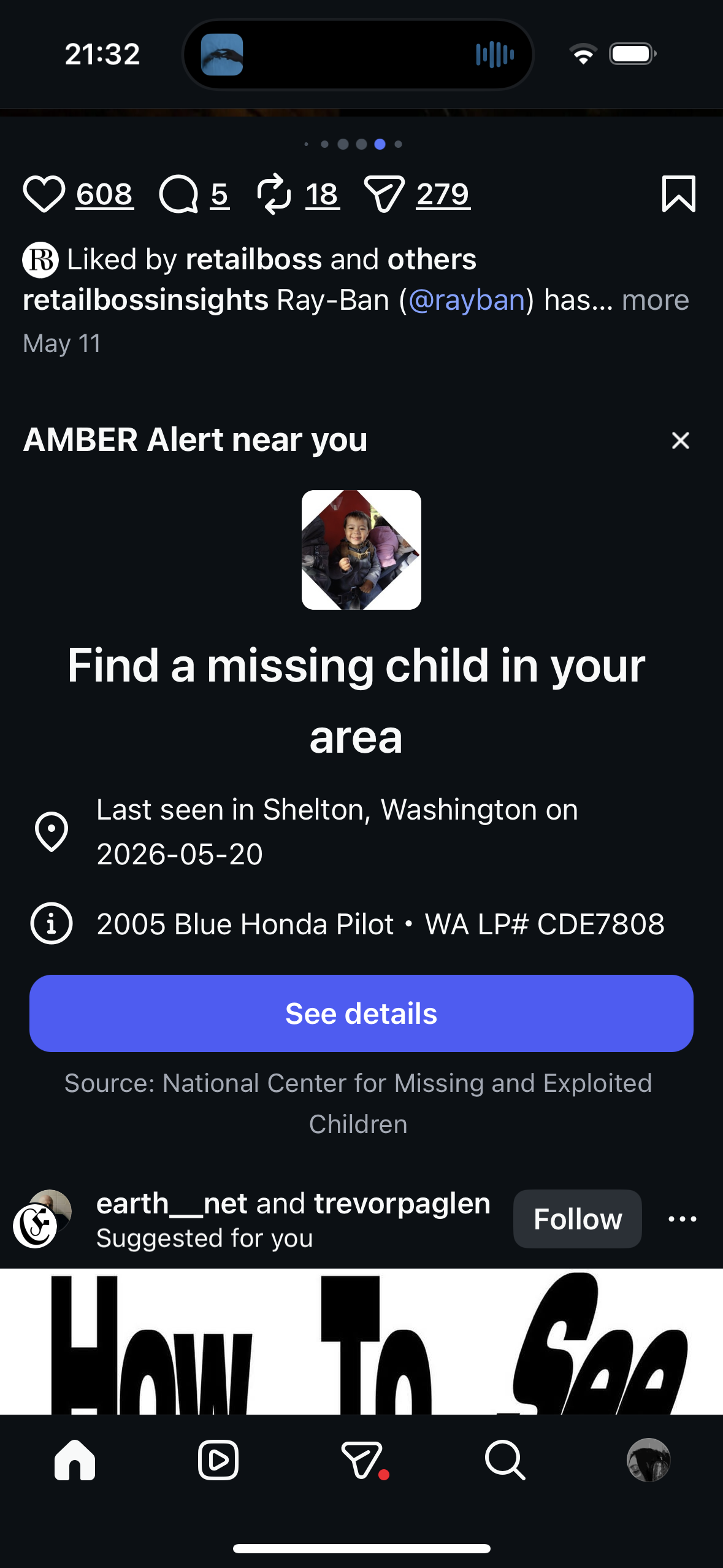
The idea for this essay kicked off when I was in Sequim, Washington for a wedding in May 2026. Not only did our phones go off with an AMBER alert, but I was surprised to see an AMBER alert embedded into my Instagram feed. When you go to Walmart and exit, there’s usually a bulletin board filled with flyers from the NCFMEC. The AMBER Alert system is one component, perhaps the most visible to the public, of a deeply intricate system.
There is something incredibly, deeply human and optimistic about the groundswell that required this system to come to life in the form it has today. It started as a call-in suggestion to a radio show, and is now a system that is implemented widely within, and outside of the United States. It also has some of the most equivocal support of any public safety initiative in the US Government history.
The power of the AMBER alert system relies on the image we have in our mind from being apart of it. We typically see a child being taken by a stranger in the day, and imagine ourselves acting as interveners. The actuality of how AMBER alerts work and when they’re deployed is a bit more complicated.
The basic premise about AMBER alerts is that speed to reporting of tips is the way to finding an abduction victim the fastest, therefore finding the abduction victim before further harm can happen.
There is also tiers of AMBER alerts: there is a primary distribution track, and then a secondary distribution track. There is also range of levels, going from local, regional, statewide, to multi-state. Each AMBER Alert system is considered a “plan” that owns a jurisdiction, and plans may co-ordinate with each other to extend an AMBER alert out as they believe abductions move over jurisdictions.
There’s also another component of WEAs, wireless emergency alerts. This is the version of the notification you might be the most familiar with: emergency alert tone, short message, to all phones opted-in in an area at a given time.
Each different region that operates an AMBER alert system has their own internal protocols for when to escalate a situation to AMBER alert status, but they are must meet basic nationalized criteria. This criteria has been provided mostly by the U.S. Department of Justice, and is mostly adhered to.
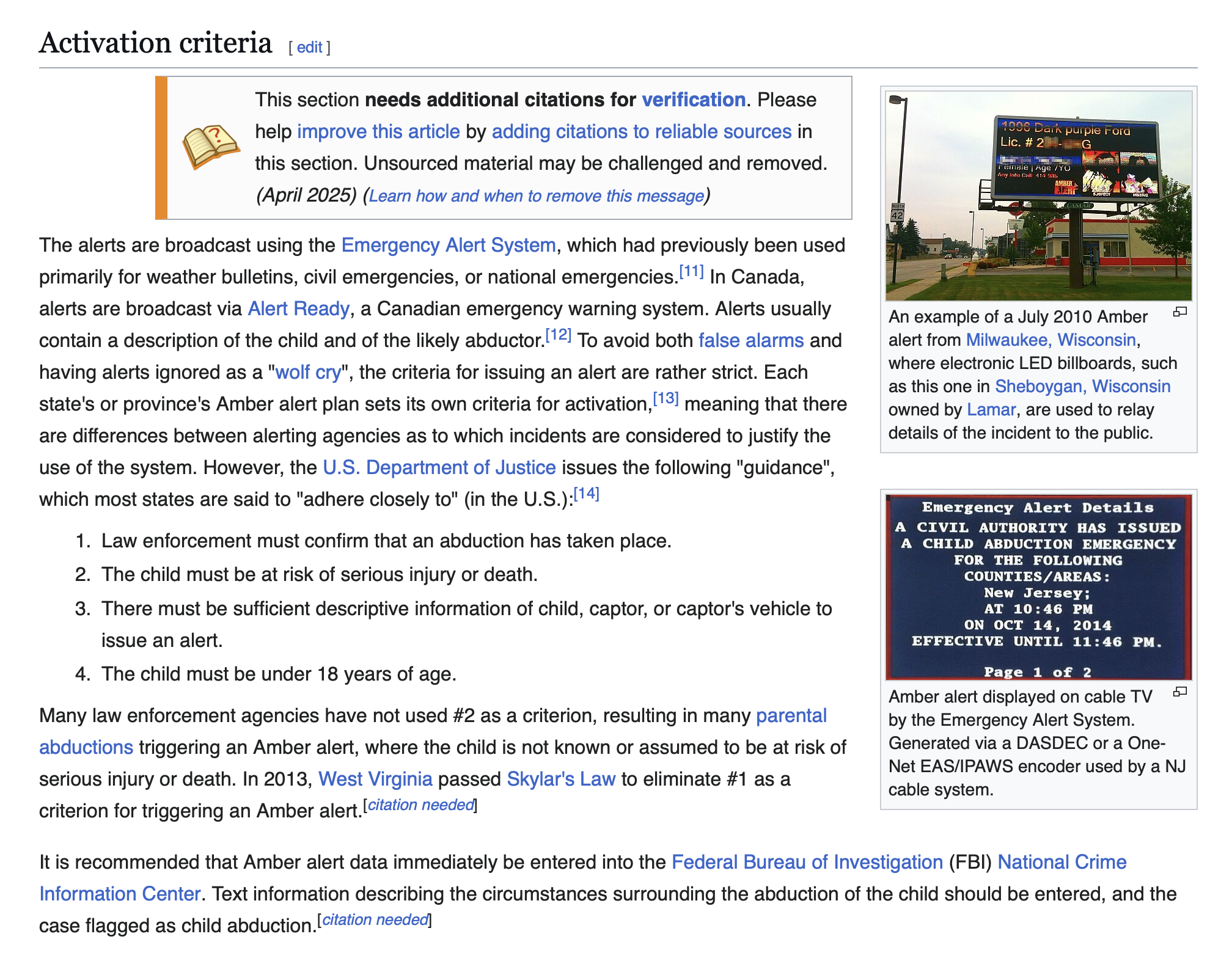
The issue primarily is that meeting the criteria is important to maintaining the fidelity of the system. At the same time, verifying a situation has met that criteria takes precious time away from the search and leaves the vulnerable party in a hard situation for longer. This fundamental premise about criteria, what defines it, and how long it takes defines the core structure of AMBER alerts, and if the alerts succeed.
According to the data, the majority of AMBER alerts are not used in situations where the child has been taken by a stranger. The majority occur when the child is taken by a parent, or known member of the family.
A very small percentage of cases exist where AMBER alerts are issued and successful in retrieving a child, when the child is kidnapped by someone that they don’t know. The National Center for Missing and Exploited Children every year releases a report about AMBER alerts and their performance that year publicly, and exposing the data of the system. This is a sample of data from 2024, the most recently available report at the time of writing.
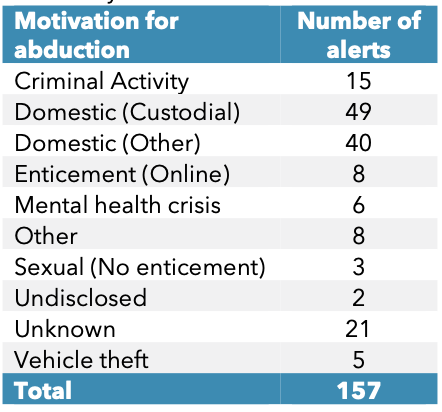
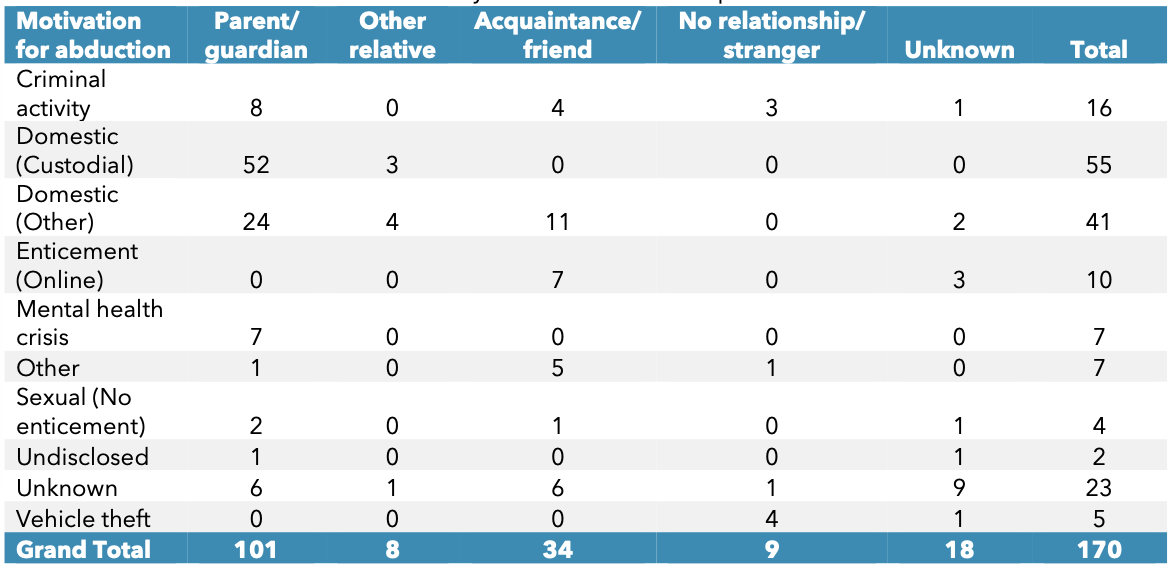
The majority of AMBER Alerts were activated for domestic motivations, by a parent or guardian. The secondary leading category was online enticement. Out of 170 alerts, only 9 could be clearly categorized as stranger. It’s also important to note that vehicle theft accounts for a majority of stranger abductions, not criminal activity or intent.
The data reflects a common misconception within child safety that the public holds: most children do not experience harm at the hands of random strangers. Most child abuse happens by family, or people known to the family. What AMBER alerts are in the mind of the public is a way to intervene in on a child in a dangerous situation with an unknown stranger. What it is often used for is to stop parental abduction during custody battles and contentious relationship issues.
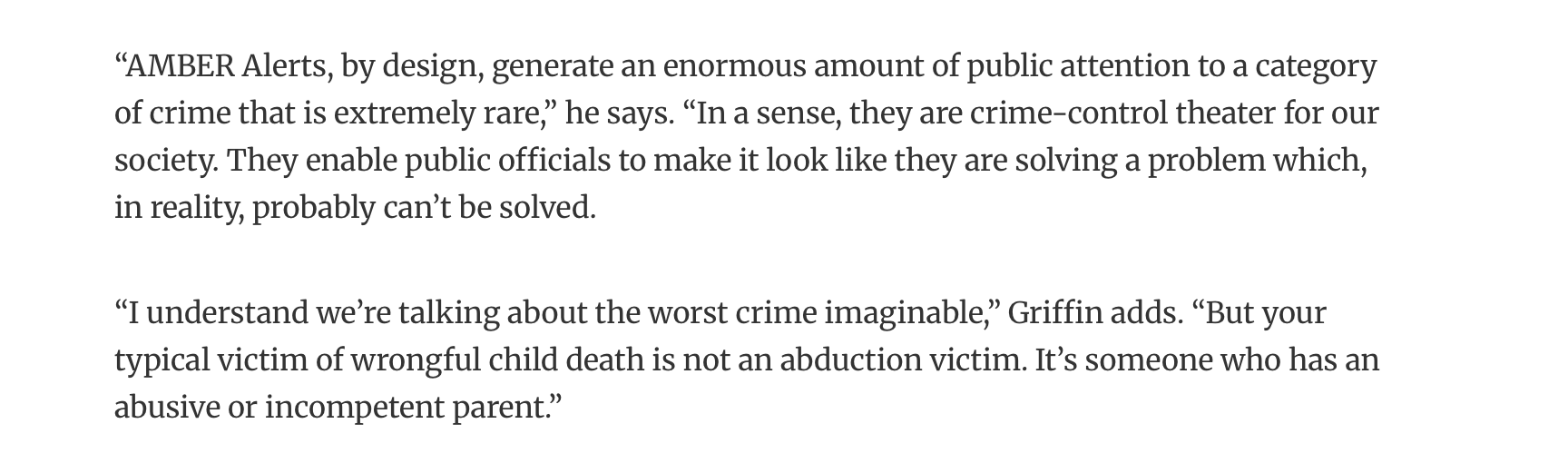
Although kids being abducted are nevertheless in danger (and the trauma from a parental kidnapping is nothing to gloss over), a child is in from being kidnapped by a parent is highly different compared to the amount of danger a kid is in from being kidnapped by a stranger.
This slight Overton window shift has major complications that taint the entirety of the system. First and foremost, public safety systems when overused can tend to lose their impact. Especially false alerts or alerts that are timed “too early” can reduce the confidence in the system, and make the public who receive the alerts feel less compelled to take them seriously in the future.
In 2024, 3% of AMBER alerts were determined to be a hoax. Even more, 14% of AMBER alerts were considered to be unfounded. So, 17% of AMBER alerts contained incorrect information. This is the balance that AMBER alerts will forever struggle with. Too long to verify information, and the time to recover can dramatically reduce the effectiveness of the system. Too little time, and cases that are unfounded reach the public and reduce the effectiveness, too.
I can almost guarantee this delicate balance is what keeps most people up who has designed the system at night.
This is a core feature of almost every project undertaken, ever. Balances and tradeoffs are what defines any system. However, if a system is as balanced as it can be, and it is still not effective: the system itself does not solve the problem it was commissioned to solve.
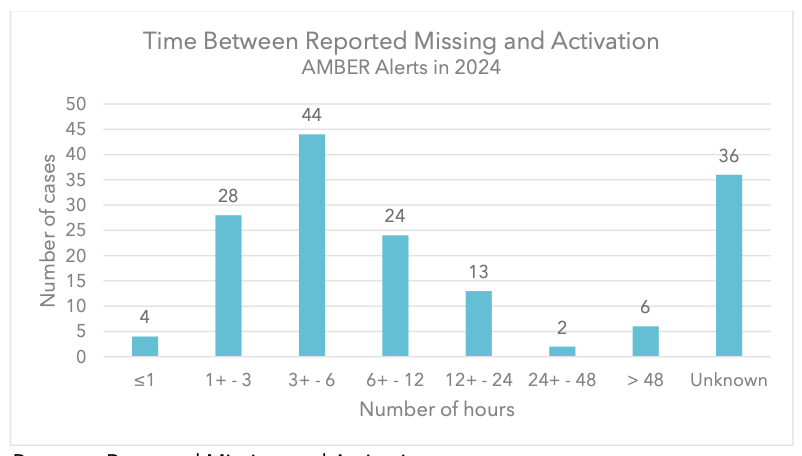
The majority of AMBER alerts are sent 3+ hours after the initial report. Keep in mind there is also a high-level of unknowns, which severely complicates what we can extract from the information. These next two chunks of data are perhaps the most indicative of why AMBER alerts do not meet what they are named for.
AMBER Alerts within the context of the problem they are supposed to solve (primarily, reducing stranger abductions and murder), are largely ineffective. When it comes to situations similar to the namesake, where a child is taken by a stranger with inhumane intentions, the time it takes to clear the hurdles of the system often means the child is irreparably harmed within the average 3 hour window it takes to issue an AMBER alert.
To repeat it more clearly: the criteria that enables the system to have fidelity at scale makes it statistically ineffective at solving the problem it is supposed to. By the time that law enforcement is able to determine all 4 are applicable, the criteria that protects the system makes it too late to respond effectively to what it’s named after.
Even beyond, AMBER alerts require witnesses, descriptions: clarity. Things that take often long amounts of time to gather and verify.
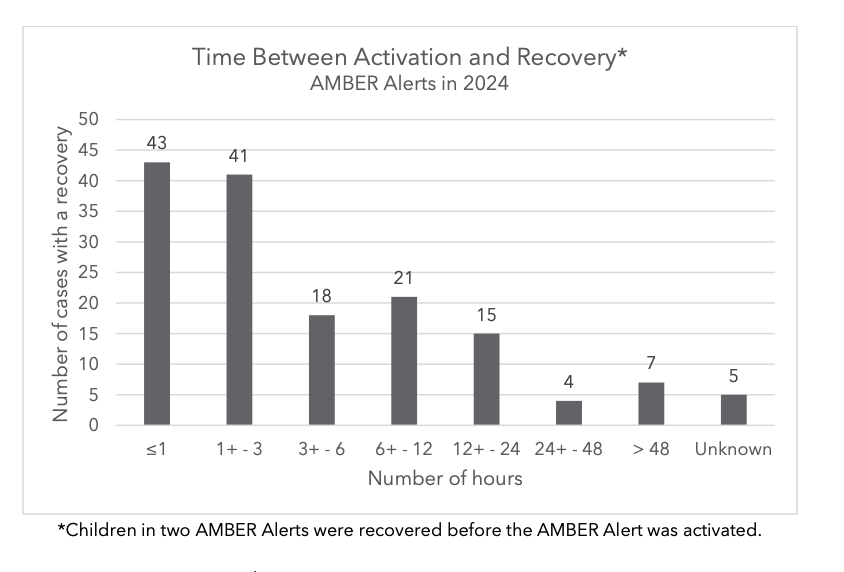
But what we can clearly see in the activation → recovery data is outstanding proof that the majority of recoveries occur in the first 3-6 hours of the alert. This makes sense for many reasons - notifications of any kind have a bit of a half-life in the mind of the public.
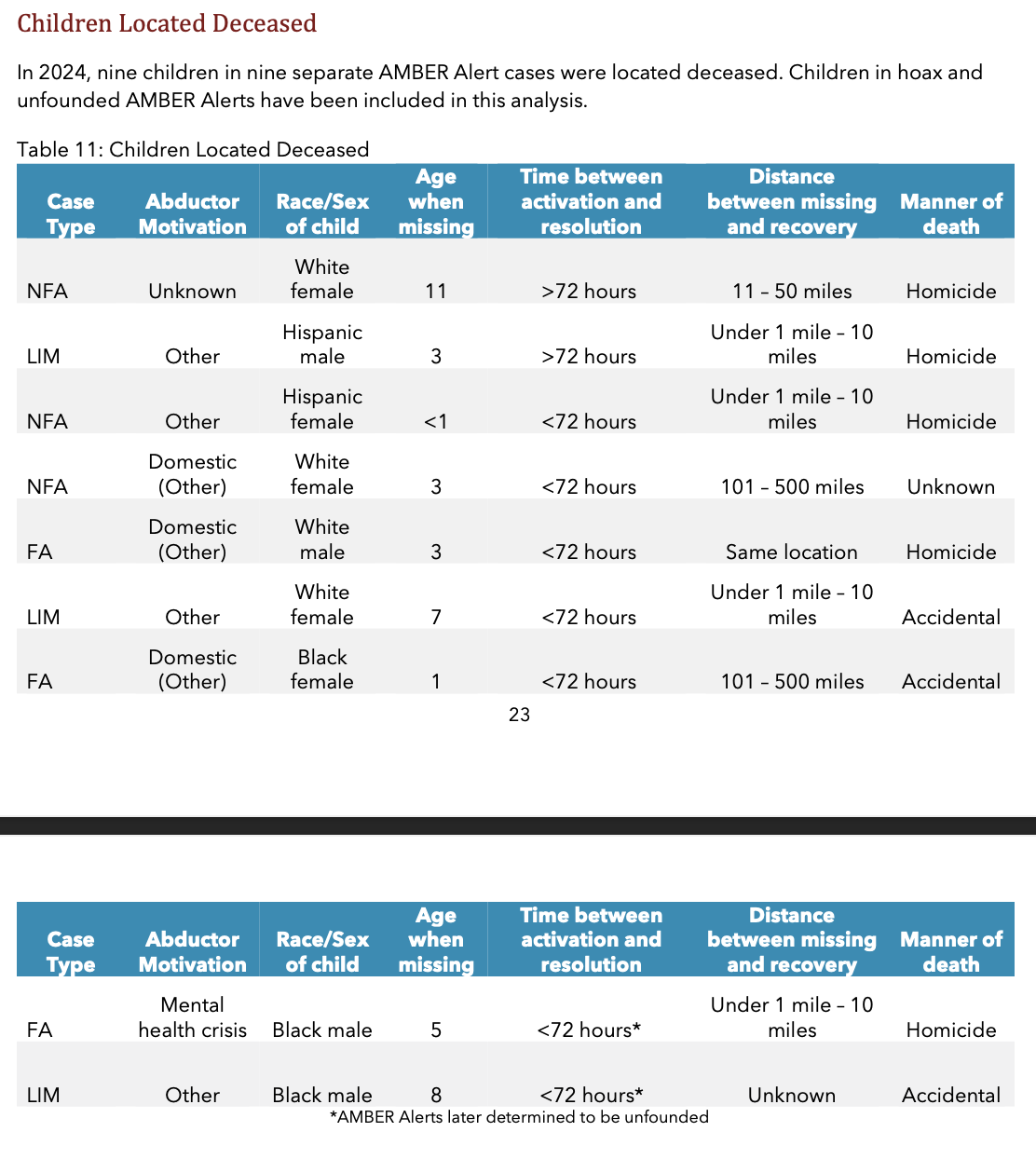
Now, for the harder aspects of the cases that don’t succeed. There was approximately 9 children who were found dead within 2024. Out of those 9 who were located deceased, 5 were murdered and the other 4 died from unrelated reasons.
In the context of the system, this makes sense. Oftentimes, a child has an accidental death away from the home and abduction is the first thought from the caregivers. Thus, a case is incorrectly fit to be a potential abduction when it could be an accidental drowning, or something similar.
The gloss of the AMBER Alert system seemingly promises an easy fix to stranger/child kidnapping, where it will often not be the case. The premise of technology being the end-all be all to this problem may in fact hide greater dangers.
Let me be nuanced and delicate in this, because I think precision in criticism of public safety systems is important. Having a way to find a child who has been kidnapped by a parent is deeply important, especially because there are known instances of children being abused or murdered by a parent. But it is not the same severity as a stranger abduction.
Storytelling is crucial to garnering support for a product or service, but it also sets the stage for the context of the utility of that product. What does it mean if the majority of the public believes AMBER alerts will save children from a fate that the system statistically does not?
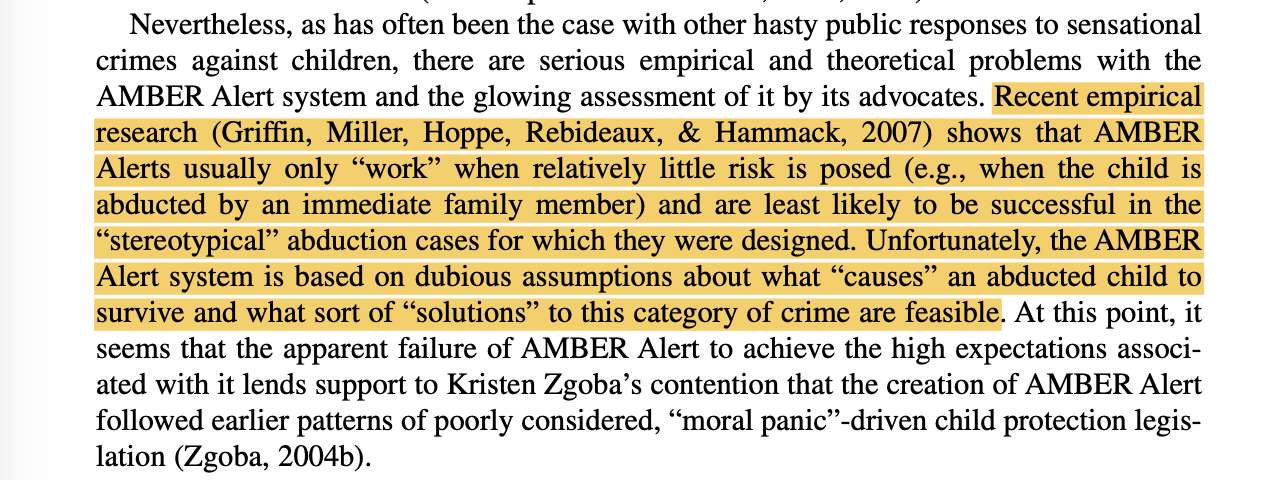
Going by the heuristic, “the purpose of a system is what it does”, the purpose of AMBER alerts is not to actually help children who have been abducted by strangers, but by parents who have abducted their kid in the midst of custody disputes. The system is successful, but not for its’ namesake or for the foremost connection most people have to it mentally.
Even then, I think there is truth to the idea that there is some things that we can never fully resolve. Some crimes that will always continue to happen, or will slip through the barriers. We would rather have imperfect solutions that don’t actually solve the problems they are claimed to, instead of a vigilance that minimizes the damages we know have happened.
From the other side of the philanthropy spectrum, I’ve been reading an incredible book called “A Bed For The Night” by David Rieff, who makes the case that the moral stance held by the West about humanitarianism actually can increase the amount of suffering experienced.
In convincing people in war-torn areas that we will step in and that we have the capacity to care, we often times provide them with false hope and ourselves with a sweet, yet ineffective, placebo of true care and help. By viewing abductions as solvable through fast logistics, we innately put ourselves in a position of always bracing for defense, and not funding the programs that could reduce child abductions from parents in custody battles in the first place.

By convincing people help is inevitable and en route, we often over-fit or under-fit political problems with a philosophy that will not resolve the core of the problem, and may actually convince the people in danger of hope when there is none. As the UN high commissioner Sadako Ogata once said, “Humanitarian problems have no humanitarian solutions”.
The book further argues that in some ways, that humanitarianism is a “fig” leaf for greater attitudes and atrocities. Because we offer X (humanitarianism, AMBER alerts), we don’t truly have to contend with Y (political atrocities, the abusive behaviors that cause abduction in the first place).
In some ways, the AMBER alert system is that. AMBER alerts do not work if someone cannot see a license plate, or get details entirely of a car. In fact, the landmark memorial case AMBER alerts were created as the namesake of, perhaps would have not met the criteria to even send out an alert.
That does not mean AMBER alerts are not effective for a very specific kind of situation, but they are not marketed as such and may act as an amputation when we should be treating a wound as it first appears.
However, if we are leveraging AMBER alerts as a way to convince ourselves that in the off-chance a child will be harmed by a stranger, all we have to do is send messages and activate the citizens around us, we are greatly mistaken. What child wellbeing truly is, is expanding access to abuser programs, reforming Child Protective Services, continuing to reform the child welfare system, and working to reduce abusive tendencies in parents that enable child-parent abduction.
It seems almost ignorant to write about a system that still, considerably helps resolve an issue (although not the one advertised), in spite of a world where many systems do nothing at all. but, I would argue there’s in some ways, more harm that comes from a system operating differently as advertised quietly, as opposed to loudly and structurally failing.
All this to say: if child safety technology is genuinely the priority, AMBER alerts are not entirely delivering on the promise, all while deceiving us that potentially it is.
But, in the case of children being abducted by strangers for murder: there is no easy fix to that. There never will be. AMBER alerts provide the idea that we are saving kids from obtuse danger, but not often the empirical evidence.
P.S: I want to end this essay with a lot of gratitude towards Timothy Griffin, who is an associate professor of Criminal Justice at the University of Reno, Nevada. He’s been doing a lot of work about the AMBER alert system and providing an empirical review of it all. It seems like he has been doing the primary bulk of advocacy on this point. A lot of the information and opinions I shared were greatly informed by his work.
Sources
AMBER Alert in Indian Country. (2019). Office of Justice Programs, U.S. Department of Justice. https://amberalert.ojp.gov/amber-alert-indian-country
Amber's legacy: A timeline. (n.d.). The AMBER Advocate, Issue 65. AMBER Alert Training and Technical Assistance Program. https://amberadvocate.org/?articles=aa65-amber-alert-timeline
Apple, C. (2026, January 13). Amber's legacy: The history behind, and of Amber alerts. The Spokesman-Review. https://www.spokesman.com/further-review/amber-alerts/
Bloomquist, J. (2018). An analysis of the unintended effects of the AMBER Alert system [Honors thesis, Bemidji State University]. https://www.bemidjistate.edu/academics/honors/wp-content/uploads/sites/73/2022/11/An-Analysis-of-the-Unitended-Effects-of-the-AMBER-Alert-System-Bloomquist-Josiah-4.23.18.pdf
Child abduction alert system. (n.d.). In Wikipedia. Retrieved June 5, 2026, from https://en.wikipedia.org/wiki/Child_abduction_alert_system
Griffin, T. (2010). An empirical examination of AMBER Alert 'successes.' Journal of Criminal Justice, 38(5), 1053–1062. https://doi.org/10.1016/j.jcrimjus.2010.07.008
Jacobs, T. (2007, December 15). AMBER Alerts largely ineffective, study shows. Pacific Standard. https://psmag.com/social-justice/amber-alerts-largely-ineffective-study-shows-4792/
Office of Juvenile Justice and Delinquency Prevention. (2024). Child Abduction Response Team (CART) implementation guide: A guide to CART program components and implementation (NCJ 309608). U.S. Department of Justice, Office of Justice Programs. https://www.ojp.gov/library/publications/child-abduction-response-team-cart-implementation-guide-guide-cart-program